
What integration solves
In most businesses the systems work individually but a person fills the gap between them: someone takes the order from e-commerce and types it into accounting, updates stock in two places, copies shipment tracking by hand. That work is invisible, repetitive and error-prone. Integration closes exactly that gap.
What matters is being able to proceed without replacing your existing systems. The layer we add speaks to each side in its own language; you don’t change your habits, the manual carrying simply disappears.
Integration types
| Type | When to use it | Time |
|---|---|---|
| One-way transfer | One system is the source, the other only receives | 1-2 weeks |
| Two-way synchronisation | Changes happen in both systems and both must stay current | 2-4 weeks |
| Instant (webhook) triggers | The other side must be updated the moment an event happens | 1-3 weeks |
| Batch / scheduled transfer | Latency is fine, volume is high | 1-2 weeks |
| Building your own API | You will expose data to dealers, customers or partners | 2-5 weeks |
The hard part: failure cases
The easy side of integration is the happy path: data goes out and the other side takes it. The real difficulty is in the exceptions: what happens if the other system doesn’t respond, if the same record is sent twice, if a field format differs from what was expected? Every flow we build includes retries, duplicate protection and notification of failed transfers as standard. We don’t deliver an integration without a monitoring screen; otherwise you find out it broke at month end.
The quality of an integration shows not on the happy path, but when the other side stops responding.
Decisions to settle before an integration starts
A few business decisions need to be made before the technical work begins. If they change later, part of the flow may have to be rewritten, so we settle them with you in the first week.
Where the master record lives
Which system is the real source for customer details, stock and prices? Each piece of data needs one answer.
The matching key
How will both systems recognise the same record: product code, tax number, email? If codes don’t line up, a mapping table comes first.
The conflict rule
If the same record changed on both sides, which one wins? In a two-way sync this rule is written down up front.
Historical data
Will old records move across too, or only new ones from today? Historical data is usually the part that needs the most cleaning.
Frequency
Instant, hourly or once a night? Minutes can matter for stock, while a daily transfer is often enough for accounting.
Who hears about errors
When a record gets stuck, who is notified and who fixes it? Name a person or a role.
The path of one order across your systems
In this flow a person only steps in for exceptions: a product code that doesn’t match, an item that’s out of stock, or a shipping system that isn’t responding at that moment. Everything else moves along without anyone watching the screen.
When a connection needs a small module alongside it
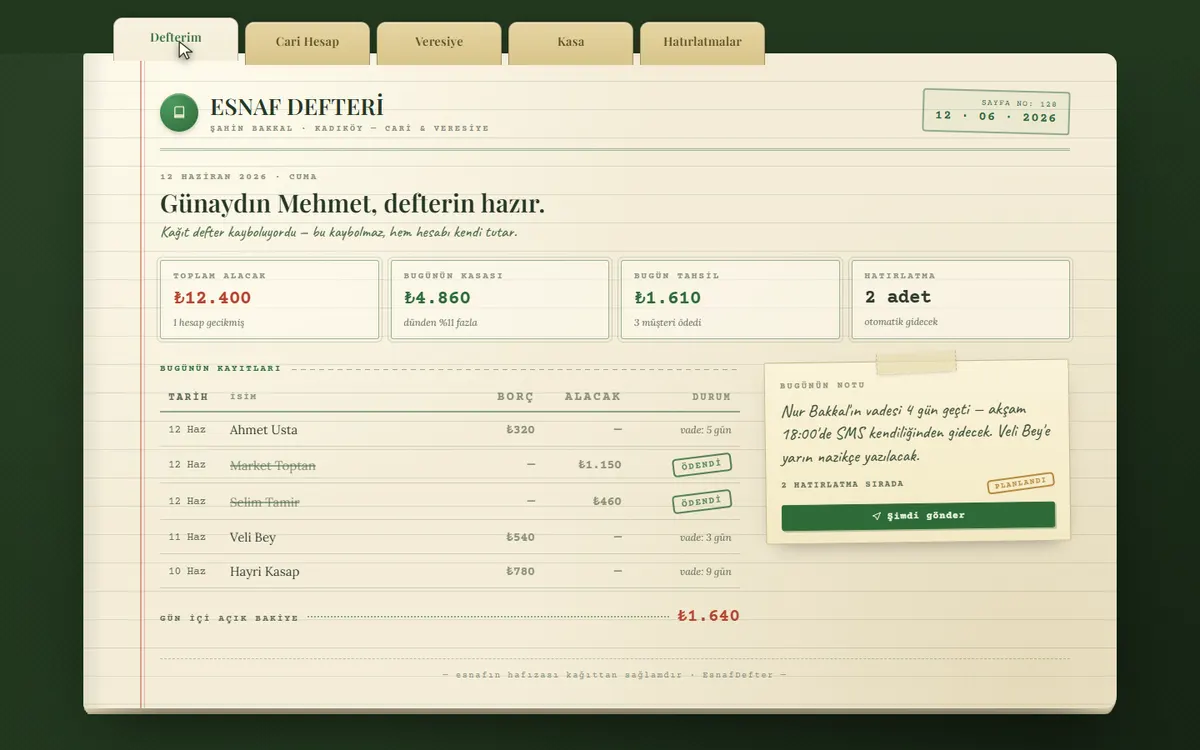
Sometimes the data is already in your ERP or accounting package, but its screens are awkward for daily work. Tracking receivables and sending payment reminders is a good example. Instead of replacing the system, we can build a small module that reads the data from it, shows it on a simpler screen and writes payments back.
Frequently asked questions
My system has no API. Can it still be integrated?
In most cases yes. Without an API we can work through export files, read-only database access or scheduled report flows. This route takes longer than an API integration (typically 3-5 weeks), but it is workable. The first step is always reviewing which exit paths the system offers.
Will integration break my existing systems?
No. The layer we build runs outside the systems and uses read-only access wherever possible. Where writing is required, it is validated in a test environment first. If your existing setup needs changes, that is discussed explicitly rather than done quietly.
What happens if a transfer fails?
The flow retries automatically; if it still fails after a set number of attempts, the record is queued and a notification is sent. From the monitoring screen you can see which record is stuck and where, fix it and re-trigger. Nothing is lost silently.
Does an integration need maintenance?
Yes, because the systems on the other side change their APIs over time. Such changes are usually announced in advance and handled with small updates. We provide monitoring and maintenance after delivery; your own team can also take it over if you prefer.
Do we need to share our system passwords for the integration?
Personal user passwords aren’t needed. Wherever the system allows, a separate integration user or API key is created with only the permissions required, and work starts in a test environment. If you like, we sign your NDA before any work begins.
Can we start one-way and move to two-way sync later?
Yes, and it’s a common route. A one-way transfer takes 1-2 weeks and two-way synchronisation takes 2-4 weeks. Starting one-way and checking that data matches correctly also makes it easier to set the conflict rules using real records.