
What makes mobile different
A mobile app isn’t a shrunken web interface. The person in the field is usually standing, using one hand, with a few seconds to spare. So on mobile the measure of good design isn’t "how many features" but "how many seconds does one record take". If a flow isn’t fast on a phone, that data never gets entered at all.
The phone is also a powerful data-entry tool. Reading an invoice or a licence plate with the camera, confirming a delivery by location or capturing a note by voice all remove manual entry.
Which approach fits you
| Approach | When it’s right | Time |
|---|---|---|
| Single codebase (iOS + Android) | Both platforms needed, shared budget and timeline | 4-8 weeks |
| Single platform | Your users are mostly in one ecosystem | 3-6 weeks |
| Mobile web (PWA) | No store release needed, zero install friction | 2-4 weeks |
| Addition to an existing app | You have an app and need a new module or a refresh | 2-5 weeks |
A mobile app without a dashboard is incomplete
Behind every mobile app there is a web dashboard where the data is managed. For a courier app it’s the screen where HQ assigns orders; for a customer app it’s where content and campaigns are managed. We plan both together, because an app delivered without a dashboard becomes unmanageable after the first week.
How a record gets from the field to head office
The real work in a mobile project is getting a record from the phone to the dashboard reliably. When a courier confirms a delivery or a technician adds a photo, the record is stored on the phone first and sent once a connection is available.
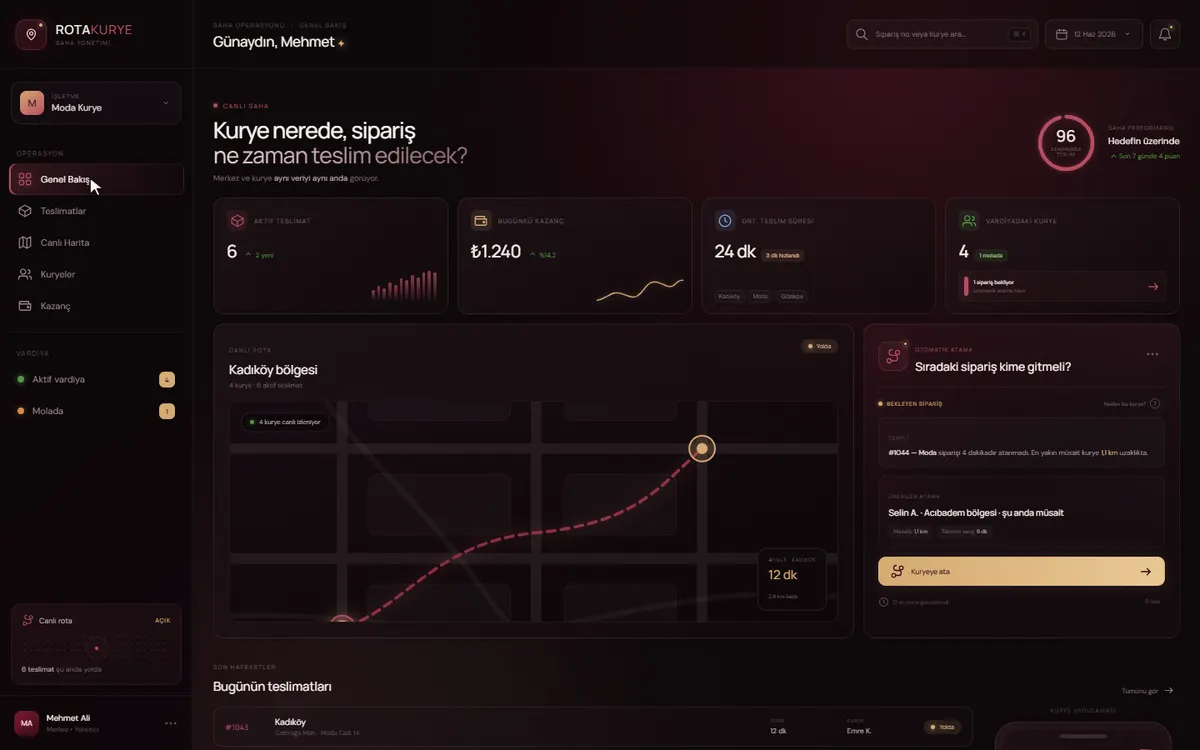
The RotaKurye demo shows the head office side of this flow: an operations screen where couriers are tracked on a map and each waiting order is assigned to the best-placed courier.
What we need from you before the store release
We prepare the icons, store screenshots and description copy. Some steps have to be taken in your company’s name, though, and that is where delays usually happen:
- Apple and Google developer accounts. Apple asks for a D-U-N-S number to open an account as an organisation, which can take a while if your company doesn’t have one yet.
- A published privacy policy page. Both stores require the link.
- If the app needs a login, a test account for the store reviewers.
- A few options for the app name. The one you want may already be taken by another app in the store.
- If the app handles personal data, a clear answer on what you will declare in each store’s data-use form.
What changes after a mobile app launches
Once the app is live, the platforms around it keep moving. Allow for these when you plan the budget:
Yearly OS releases
iOS and Android ship a new version every year. The app needs testing on it and, where necessary, an update.
Every update is reviewed
Even a small fix goes through store review. Leave a few days’ margin for urgent fixes.
Store rules
Apple and Google update their rules regularly. A new rule can mean changes to an older screen.
Users on older versions
Not everyone updates straight away. Back-end changes are planned so they don’t break older versions.
The first 30 days
Bug fixes are free for 30 days after launch. After that, a monthly retainer is the usual fit.
Frequently asked questions
How long does it take to build a mobile app?
A first version with iOS and Android builds from a single codebase is typically ready in 4-8 weeks; a single platform takes 3-6 weeks, and mobile web that needs no store release takes 2-4 weeks. These figures exclude App Store and Google Play review, for which you should budget roughly a week each.
Are iOS and Android developed separately?
No, we ship to both platforms from a single codebase. This lowers both time and cost noticeably and keeps the two platforms updated together. Only where a platform-specific hardware requirement exists is that part written separately.
Do you publish the app to the stores?
Yes, we run the release process: icons and store artwork, description copy, privacy policy requirements and the review process. Accounts are opened in your name; ownership of the app always stays with you.
Will the app work without an internet connection?
Where it needs to, yes. In field apps offline operation is usually essential: records are held on the phone and synchronised automatically once connectivity returns. This behaviour must be planned into the first version; adding it later means rebuilding the data model.
Who pays for the store accounts?
The accounts are opened in your name, so you pay the fees directly. Apple’s developer programme has a yearly membership fee and Google Play a one-off registration fee, both paid straight to Apple and Google.
Who handles updates after launch?
Updates are prepared for both platforms together from the single codebase, and each one goes through store review. Bug fixes are free for 30 days after launch; after that we carry on under a monthly retainer or job by job. Because the source code is handed over to you, another team can also take it on.