
When custom software is the right call
If your process is the same as everyone else’s in your industry, an off-the-shelf package is faster and cheaper. If your process sets you apart, if several systems have to be connected, or if per-seat licensing keeps growing, custom software is the better fit. The most common practical route is hybrid: standard work stays in a ready-made product and the layer specific to you is built separately.
What we build changes with the screen it runs on, while the approach stays the same: a CRM in the browser, a mobile app for the field team, a desktop program that works offline, or a kiosk at the shop entrance. Behind all of them are the same team and the same way of delivering.
Scope and timing on a custom software project
A first version with one flow and one type of user is working within 2-4 weeks. What really stretches the timeline is adding user types and systems to connect: a portal where your customers log in with their own accounts takes 6-10 weeks, and a system that exchanges data with the tools you already use takes 8-12 weeks.
| Scope | What it includes | Time |
|---|---|---|
| First version (MVP) | One flow, one user type, basic reporting | 2-4 weeks |
| Operations dashboard | Several flows, roles, alerts, mobile access | 4-8 weeks |
| Customer portal | External user accounts, self-service screens, permissions | 6-10 weeks |
| Integrated system | Links to existing systems, data migration, reporting | 8-12 weeks |
The budget follows the scope and is settled in writing after the scoping call. If you want to compare, our published budget bands, rates by role and scope timelines are on the pages below (as of October 11, 2026).
Cost and timeline guide
Every budget band, our rates by role and the timeline for each scope tier, on one page.
Pricing
The four engagement models, payment terms and what the price covers.
Your project has an owner
Every project has one person accountable for it: the product owner. When you want to ask something, change a priority or find out where things stand, you know who to call, and you don’t have to chase developers one by one. Here is what you can hold us to:
- One point of contact: a product owner whose name and working hours you know
- A working version you can open and use on the same day every week
- An open task list showing what is done and what is next
- Scope changes come in writing: time and budget impact within 24 hours
- Free bug fixes for 30 days after launch
How does a custom software project run?
The first few days go on discovery and a clickable prototype. A working version is typically in your hands within 2-4 weeks, and a new one follows every week after that. We keep these early steps short because most time on custom software is lost in the weeks when nobody is quite sure what is being built.
- 01
Discovery
1-2 daysIt starts with a free 30-minute call. We talk through the process, the users and the systems to connect, then pick the flow for the first version together.
- 02
Written scope and quote
We write down what the first version includes and what it leaves out. The price and the engagement model follow from that document.
- 03
Prototype
2-4 daysYou click through the main screens and approve the flow before any code is written.
- 04
Weekly versions
2-4 weeksThe first working version is typically ready within this window. After that, a new version you can open and try arrives every week.
- 05
Launch and the first month
30 daysWe go live with real users. Any bugs that surface in the 30 days after launch are fixed free of charge.
Who works on your project
Every project has a product owner who is your single point of contact. Analysis, architecture, development and testing are shared among the rest of our seven-person team, and how much each role is involved depends on the size of the project.
Product owner
Your single point of contact. Sets priorities with you, presents the weekly version and puts scope changes in writing.
Business analyst
Writes your process down step by step, including the rules, the exceptions and who signs off what.
Senior developer, tech lead
Designs the data model and architecture, reviews the code and owns the technical decisions.
Developers
A mid-level developer and two junior developers build the screens and integrations under the tech lead’s direction.
Senior QA
Tests each weekly version and the key flows before launch, and tries to catch bugs before they reach you.
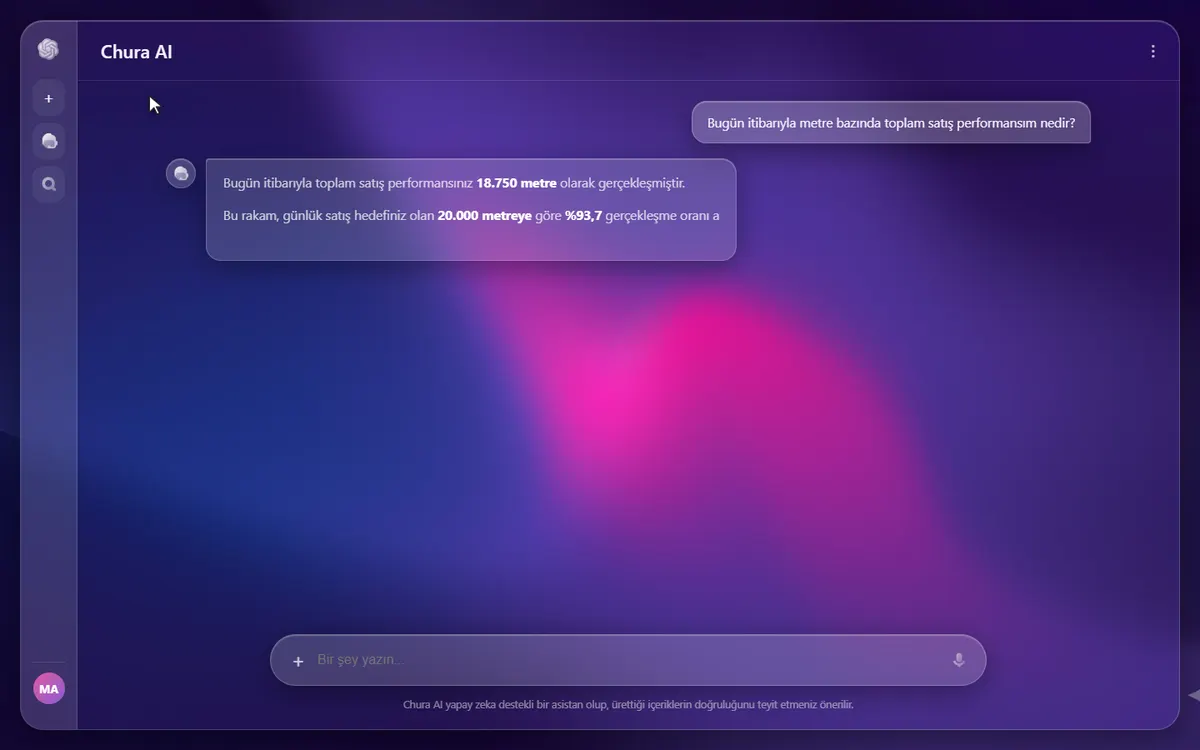
Example screen: an assistant that answers questions about sales
Custom software can be more than forms and tables. In the Chura AI demo, a business owner asks about today’s sales in a chat window and gets figures compared against the daily target. A similar layer can sit on top of your own CRM or ERP data.
Which engagement model fits your project
If you can write down today what the first version has to do, fixed scope suits you, because you know the total cost before work starts. If what you need will only become clear once you start using it, go with time and materials: the total isn’t fixed up front, but you can change priorities every week.
| Model | When it fits | Payment |
|---|---|---|
| Fixed scope | What the first version must do is clear and can be written down | 30% up front, the rest across delivery milestones |
| Time & materials | Priorities may shift week to week and the scope will firm up as you use it | Hours worked, at US$25-60 per person-hour depending on the role |
| Monthly retainer | The software is live and needs steady improvements and support | A fixed monthly package |
| Dedicated team | You want a team working only on your long-running product | 2-6 engineers, billed monthly, minimum 3 months |
Frequently asked questions
How long does custom software development take?
It depends on scope. A working first version covering a single flow is typically ready in 2-4 weeks; an operations dashboard with roles and alerts takes 4-8 weeks; a system integrated with your existing tools takes 8-12 weeks.
How is the cost of custom software determined?
Our rates are US$25-60 per person-hour, depending on the role. Fixed-scope projects get a single total price after a scoping call, with 30% up front and the rest across delivery milestones. The main drivers are scope, the number of platforms, integrations and data migration.
Who owns the source code?
The source code stays with Pepechura; you get a perpetual licence to use the software, and your data is always yours. If you want the source code transferred to you, that is available for an additional fee, set out separately in the quote. If Pepechura ever ceases trading, the source code is handed over to you.
Can you build our own CRM or ERP?
Yes. We can build a CRM or ERP entirely around you, or add the module your current ERP is missing. Data exchange with the existing system runs through an integration layer.
What should I prepare before the scoping call?
Nothing is required, but a few things speed it up: samples of the spreadsheets or forms you use today, who will use the software, which systems it has to connect to, a target date and a rough budget range. Even a one-page note describing the process helps.
What happens if the scope changes mid-project?
We send you the time and budget impact of the change in writing within 24 hours. The decision stays with you: add it now, move it to a later phase or drop it. The open task list shows where each change has landed.
Do you sign NDAs, and how do you invoice?
Yes, we sign your NDA and can work under your own MSA and SOW. Invoices come from our registered business in Türkiye, and you can pay by SWIFT transfer (USD or EUR), Wise or Payoneer.